Dunhuang & Gobi
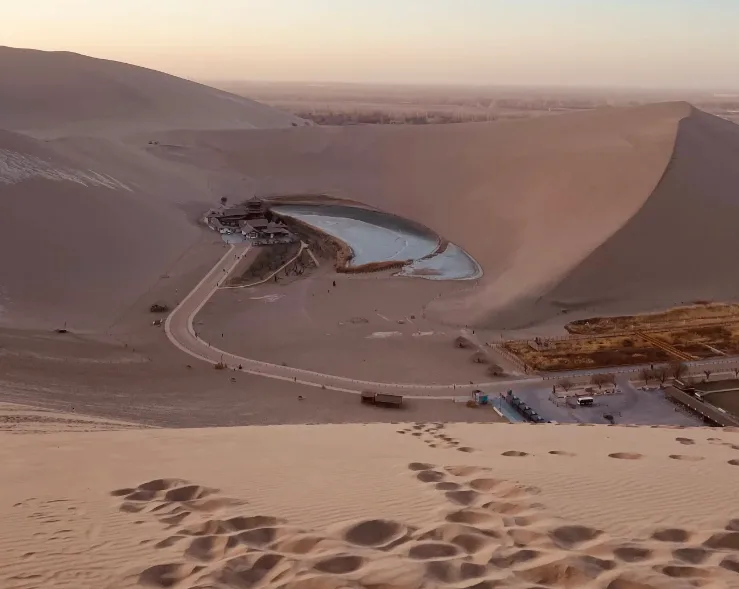
End of the ancient Silk Road — singing sand dunes, the Crescent Lake oasis, and the 1,600-year-old Mogao Buddhist cave temples carved into the desert cliffs.
Singing sand dunes, the Crescent Lake oasis and Mogao Caves on the Silk Road.
About Dunhuang & Gobi
Dunhuang was the last stop on the ancient Silk Road before caravans crossed the Taklamakan — a thousand-year-old oasis town where Buddhist monks carved 735 caves into a sandstone cliff and merchants traded silk for gold. Today the highlights are the Mogao Caves (a UNESCO treasure) and the singing sand dunes of Mingsha Shan, which contain a tiny spring-fed lake that has not dried up in 2,000 years.
Facts at a Glance
The physical and historical details of Dunhuang & Gobi — useful for understanding the landscape and planning your visit.
| Landscape type | Gobi desert basin with crescent barchan dunes and oasis springs |
| Elevation | 1,138m in town, dunes up to 250m high |
| Area | Mogao Caves 0.4 km² of carved cliff; Crescent Lake 1.4 hectares |
| Climate | Continental desert, very dry, hot summers (up to 40°C), cold winters (-15 to 5°C) |
| UNESCO status | Mogao Caves — UNESCO 1987 |
Mogao was founded in 366 CE when a monk carved the first cave into the sandstone cliff. Over the next thousand years, monks, merchants and pilgrims added 735 caves containing 2,100 Buddhist statues and 45,000 m² of wall paintings — a unique record of Silk Road trade, religion and art. The library cave (Cave 17) revealed 50,000+ manuscripts when rediscovered in 1900.
Top things to do
- Tour the Mogao Caves, the 1,600-year-old Buddhist grottoes with 45,000 m² of wall paintings
- Camel-trek or sand-board down the Mingsha Shan dunes at sunset
- See Crescent Lake, the spring-fed oasis tucked between 250m dunes
- Drive to the Yumen Pass and Yangguan Pass, the two ancient Silk Road gateways
How to get there
Fly direct to Dunhuang (DNH) from Lanzhou, Xi'an or Urumqi. The airport is 13km from town. Or take the high-speed rail to Dunhuang via Liuyuan (the nearest station, 2 hours by connecting bus). The overnight train from Xi'an or Lanzhou is a budget option.
Best time to visit
May, September and October — warm enough for the dunes, cool enough to walk the caves comfortably, low wind. Avoid July and August for heat and crowds; avoid winter if you plan a desert camp stay.
Season by season
Mild (10–25°C), wildflowers in the oasis, fewer crowds. Best overall season for combining Mogao with the dunes.
Hot (25–40°C) and dusty, with sandstorms possible in July. The dunes are at their warmest; visit at sunrise or sunset only.
Cool (5–22°C), clear skies, low humidity. Melon harvest season — try the local Hami melons. Recommended season.
Cold (-15 to 5°C), quiet, occasional snow on the dunes. Mogao Caves open year-round; the dunes are visited by almost no one.
Suggested itinerary
Morning guided tour of Mogao (2 hours), then the Dunhuang Museum in the afternoon for context.
Visit Mingsha Shan and Crescent Lake in the late afternoon, stay for sunset, and walk back under the stars.
Half-day trip to Yumen Pass, or stay overnight in a desert camp for the stars.
What it really costs
A realistic per-person day budget for Dunhuang & Gobi, excluding international flights. Prices in CNY (1 USD ≈ 7.2 CNY).
Editor's pro tips
Five things we'd tell a friend before they go — the practical details you won't find in a brochure.
- Book Mogao Caves tickets at least 7 days ahead — only 6,000 daily visitors, all timed-entry
- Buy the Class A ticket (CNY 238) for the full 8-cave guided tour; the cheaper B and C tickets are far less rewarding
- Visit the dunes at sunset, not midday — the sand is too hot, and the dunes are unphotogenic flat-lit
- Stay one night in a desert camp — the stars over the Gobi are exceptional and the silence is unforgettable
- Bring a scarf, sunglasses and a layer of clothes even in summer — the temperature drops 15°C after sunset