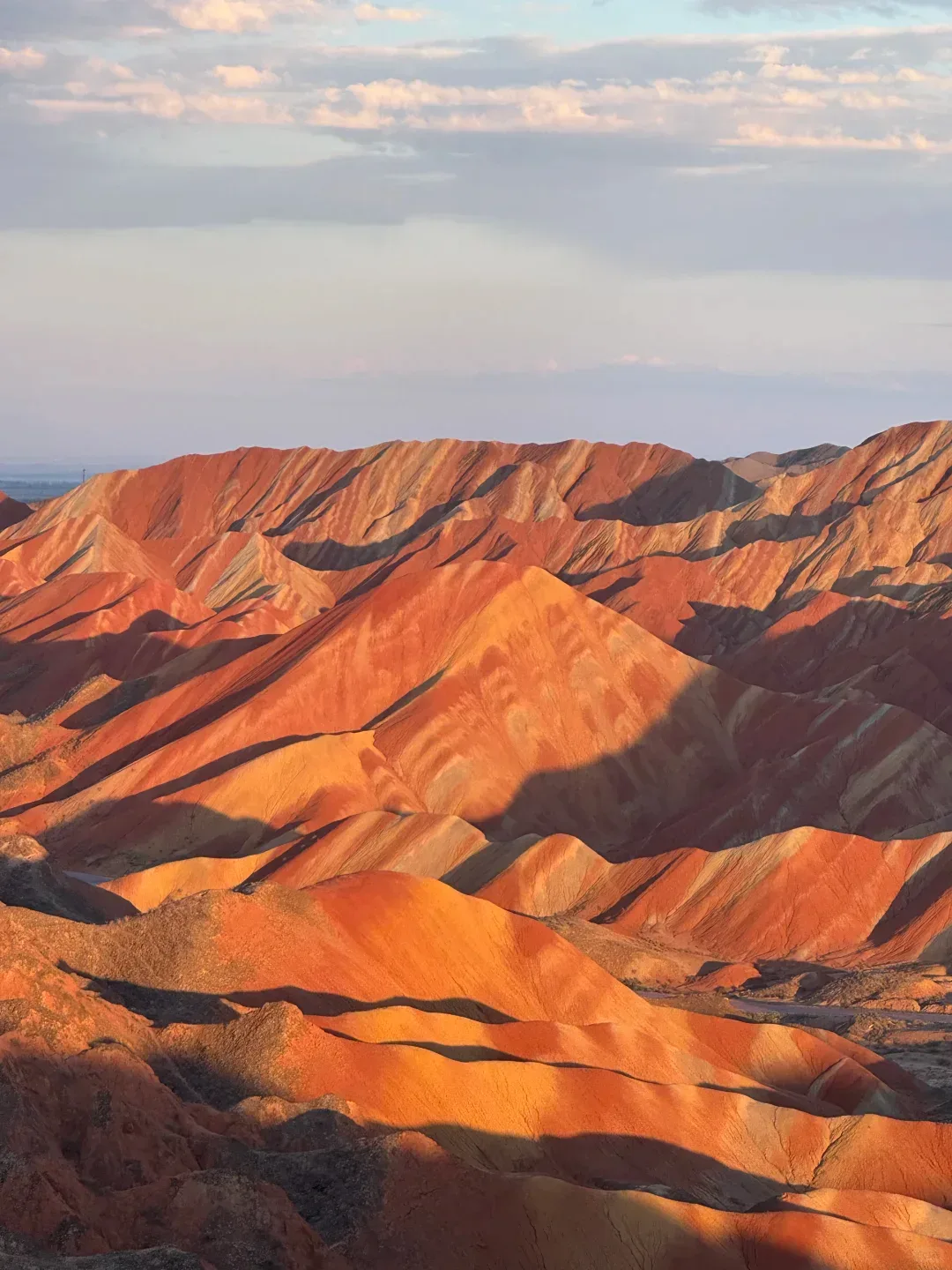
Zhangye Danxia
The Rainbow Mountains — striped ridges of red, orange and cream sandstone that look airbrushed but are entirely natural, formed over 24 million years of mineral deposition.
Rainbow-striped hills that look like a painting — most vivid at sunrise and sunset.
About Zhangye Danxia
Zhangye Danxia is the 'rainbow mountains' of China — striped ridges of red, orange and cream sandstone that look airbrushed but are entirely natural, formed over 24 million years of mineral deposition. It is worth visiting as a one-day photography stop on a Silk Road route, and it is one of the easiest big sights in China to see: boardwalks and shuttle buses run between viewpoints, with no hiking required. Most travelers need just half a day, timed for sunset.
Facts at a Glance
The physical and historical details of Zhangye Danxia — useful for understanding the landscape and planning your visit.
| Landscape type | Danxia landform (red sandstone and mineralized conglomerate) |
| Elevation | 1,500–2,500m, rolling ridges and cliff bands |
| Area | 510 km² scenic area, four official viewing platforms |
| Climate | Continental semi-arid, cold winters (-15 to 5°C), warm summers (15–30°C) |
| UNESCO status | Not UNESCO (proposed 2010; remains a national geopark) |
The Silk Road passed within 30km of the park for over a thousand years, and caravans traveling between Chang'an (Xi'an) and Dunhuang would have used the ridges as a landmark. The area was first photographed for international audiences in 2005 by a Chinese photographer whose images went viral and triggered a tourism boom.
Top things to do
- See the striped hills from the four main viewing platforms, each with a different angle on the colors
- Time your visit for late afternoon, when low sunlight saturates the reds and oranges
- Photograph the 'rainbow' layers at their most vivid just before sunset
- Pair it with the nearby Pingshan Lake Grand Canyon for a second, quieter desert landscape
How to get there
Fly or take high-speed rail to Zhangye city (on the Lanzhou–Urumqi line), then a taxi or shuttle the 40km to the Danxia park. The main north gate and the quieter west gate both have shuttle buses that loop the viewing platforms.
Best time to visit
Year-round, but the colors are strongest in clear weather — spring and autumn are ideal. Sunset and the hour after sunrise give the most saturated reds. Avoid midday in summer, when the light flattens the stripes and the heat is intense. Winter is cold but offers clear air and far fewer visitors.
Season by season
Mild (5–22°C), wildflowers along the access road, fewer crowds. Colors are clear but not yet at their most saturated.
Warm (15–30°C), sun is high and harshest at midday — colors look washed out. Avoid 11am–3pm; the morning and evening are still excellent.
Clear air, cool (5–20°C), low sun angles. Best balance of color saturation, weather and crowd levels.
Cold (-15 to 5°C), occasional snow, almost no tourists. Striped hills dusted with snow are striking; some viewpoints may be slippery.
Suggested itinerary
Arrive mid-afternoon, ride the shuttle through the four platforms, and stay for the golden hour when the striped hills glow.
What it really costs
A realistic per-person day budget for Zhangye Danxia, excluding international flights. Prices in CNY (1 USD ≈ 7.2 CNY).
Editor's pro tips
Five things we'd tell a friend before they go — the practical details you won't find in a brochure.
- Enter via the west gate, not the main north gate — half the lines, same access to all four platforms
- Photograph Platform 2 at sunset, Platform 1 at sunrise — they have the most colorful exposures
- Pair with Pingshan Lake Grand Canyon (30 minutes away) the next morning — a quieter, more dramatic landscape
- Bring a polarizing filter — it cuts the haze and brings out the layer colors you cannot see with the naked eye
- Do not climb on the ridges — fines are steep and the soft sandstone erodes easily